
Reviewed · SELF-GUIDED TOURS
Glasgow Private Self-Guided Tour
Glasgow turns history into street art. This self-guided route blends medieval landmarks with murals by Smug, plus a smooth ending at St Enoch.
I love that it is designed for your pace, with short, specific stops and a real narration voice (Alex), not a robotic read.
One thing to consider: the phone app and GPS steps can feel a bit clunky, so you’ll want a charged battery and patience if audio does not start right away.
In This Review
- Key highlights you will feel on the walk
- A 2 to 3 hour Glasgow route that moves from Cathedral to City Centre
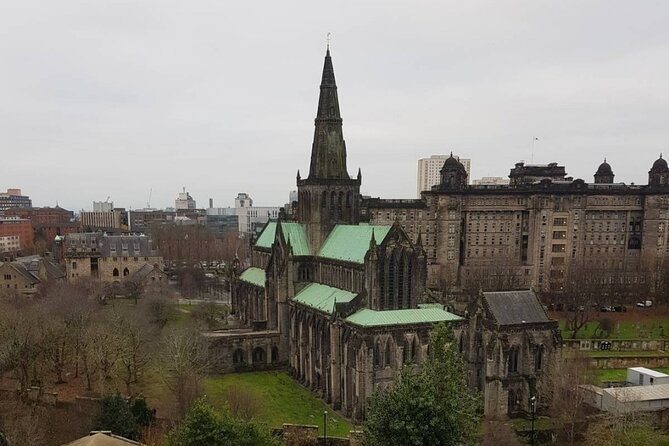
- Start at Glasgow Cathedral, built after the big fire, still in use
- Glasgow Necropolis: a graveyard you can walk through, like a 19th century park
- Provand’s Lordship and the older Glasgow you do not notice at first glance
- Murals all the way: University of Strathclyde to Smug street art
- Tron church tower, Trongate, and Glasgow’s street names with a story
- The police history museum stop, plus how Glasgow tells its own story
- The mural called Fellow Residents of Glasgow by Smug
- 98 Ingram St and the tobacco merchants who bought status in stone
- Mercury, City Chambers, and George Square, with Queen Victoria in the mix
- Glasgow’s emblem, a major gallery stop, and a Mackintosh-inspired tea room break
- Buchanan Street, The Lighthouse visitor centre, and finishing at St Enoch
- Price and value: why $12.37 can work if you like self-guided time
- App and audio reality check, based on what to expect on the ground
- Who should book this Glasgow self-guided tour
- Should you book this Glasgow Private Self-Guided Tour?
- FAQ
- How long is the Glasgow Private Self-Guided Tour?
- What language is the audio tour offered in?
- Does this tour include a live guide?
- Is admission included for the sights on the route?
- Where does the tour start and where does it end?
- Do I need to download an app to use the tour?
- What is included in the tour price?
- Is the tour refundable if I cancel?
Key highlights you will feel on the walk
- Alex narrates, in natural human voice, with audio, videos, pictures, and practical recommendations
- Many stops are listed as free, so most of what you do costs nothing beyond your time
- St Mungo and St Enoch stories show up in multiple stops, not just in one landmark
- Murals are not afterthoughts, you get named works like the Fellow Residents of Glasgow by Smug
- You get a true “then to now” route, from Glasgow Cathedral and the Necropolis to Buchanan Street
- You finish at St Enoch Subway, near the Roman Fort area, which makes transit easy
A 2 to 3 hour Glasgow route that moves from Cathedral to City Centre
This tour is built for a 2 to 3 hour walking window, but you can stretch it if you like to pause. The stop lengths are generally short, like 5 minutes at a mural or statue, then longer pauses for the Cathedral and Necropolis. It is private, so it is only your group, which helps if you want to linger without feeling rushed.
The biggest practical advantage is that you are not just following a list of pins. You are given a map, directions, and a GPS route inside the Pandemic Tours app, then an audio guide that talks you through each spot in sequence.
A few more Glasgow trips to weigh up
- Private Tour of the Scottish Highlands from Edinburgh
★ 5.0 · 325 reviews - Private Tour of Highlands, Oban, Glencoe, Lochs & Castles from Glasgow
★ 5.0 · 169 reviews - Half-Day Private Glasgow Must-Sees Tour
★ 5.0 · 165 reviews
Start at Glasgow Cathedral, built after the big fire, still in use
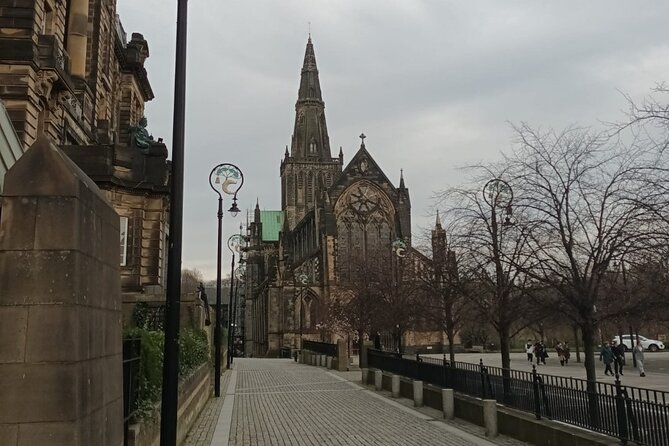
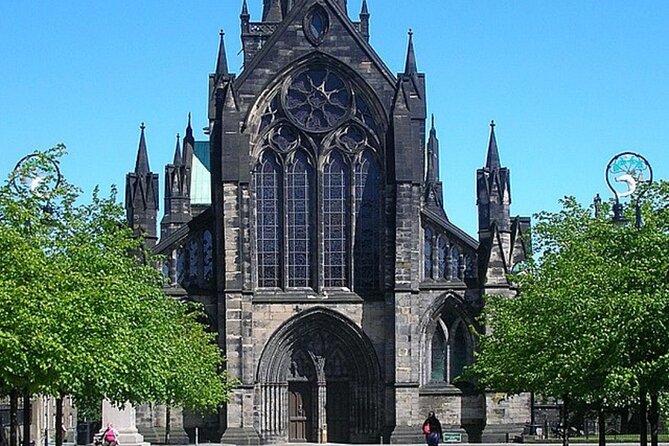
Your walk begins at Glasgow Cathedral. This is the version dating to 1197, rebuilt after an earlier Cathedral that was hit by a fire shortly after being built in 1136. What makes this place special is continuity. The worship of God has been carried out in the Cathedral’s walls for more than 800 years, and that long thread shows in how the building feels.
A practical tip: go in with a quick plan. Spend a few minutes looking at the main features, then let the audio guide steer you to what to notice in the surroundings around the Cathedral, not just the building by itself. The stop is about 30 minutes, so you can do it without sprinting.
Glasgow Necropolis: a graveyard you can walk through, like a 19th century park
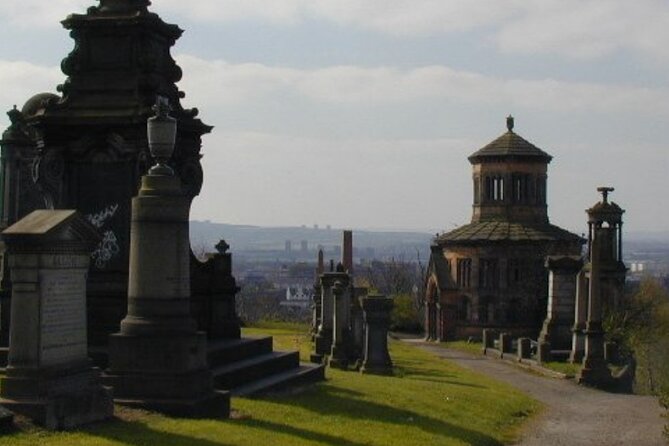
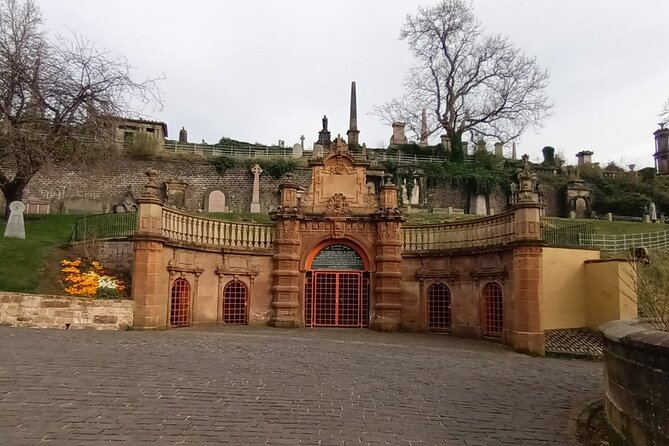
Next up is the Glasgow Necropolis, Glasgow’s best-known graveyard. It began in 1831, copying the idea of Père Lachaise in Paris. The reason wealthy Glaswegians invested in the Necropolis is simple: they wanted to present themselves properly, even after death. Over 37 acres, it is an impressive scale, and the audio makes that size feel real.
If you like urban history, this stop pays off because you see how the city thought about status and memory. The tour gives you about 15 minutes, which is enough to get oriented and understand the bigger idea without trying to read every marker.
Provand’s Lordship and the older Glasgow you do not notice at first glance
After the Necropolis, the tour shifts into smaller, quieter history. You stop at a stone building called Provand’s Lordship. Since the late nineteenth century it has carried that name, but before that it was known as the Hospital of St Nicholas.
This is the kind of stop where the audio matters. You do not need to be a museum person to enjoy it. You are basically learning how Glasgow repurposed buildings over time, and why these older stones feel like they survived many versions of the city.
A different kind of day out in Scotland:
- Guided Celtic Park Stadium Tour
★ 5.0 · 3,136 reviews - Tennent’s Brewery Tours Ticket
★ 5.0 · 1,938 reviews - City Sightseeing Glasgow Hop-On Hop-Off Bus Tour
★ 4.5 · 1,873 reviews - Oban, Glencoe, Highlands Lochs & Castles Small Group Day Tour from Glasgow
★ 5.0 · 1,432 reviews
Murals all the way: University of Strathclyde to Smug street art
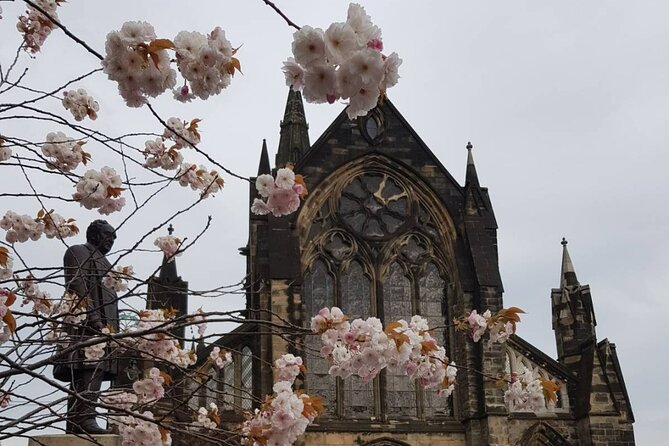
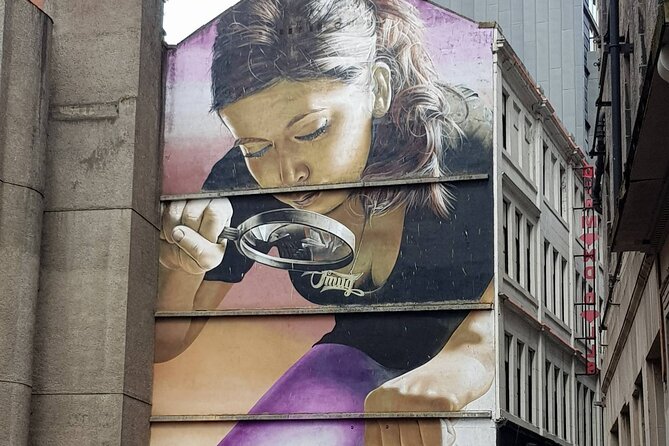
Glasgow is famous for murals, and this tour treats that as a main theme, not a side quest. You get a mural trail that focuses on revitalizing neglected walls and gable ends, plus changing how people think about street art.
You pass University of Strathclyde, one of Glasgow’s major universities. The stop is about 15 minutes, and the tour points you toward murals and architecture worth seeing without needing a guide for every detail. If you only have a short time in Glasgow, this is a smart way to catch the city’s street-art identity quickly.
Then you get one of the most specific, easy-to-spot works: the mural of St Enoch cradling St Mungo. It is described as a futuristic representation of the saint, and you spend around 5 minutes focusing on the details and the history behind what inspired it.
Tron church tower, Trongate, and Glasgow’s street names with a story
Next, you look up at the tower of Tron church, which today is the Tron Theatre, and you learn about the street called Trongate. The audio also explains that the area was originally known as Saint Thenew’s Gait, tied to the supposed burial site of Thenew, better known as Saint Enoch, who is St Mungo’s mother.
This stop is short, but it is a good example of how Glasgow hides meaning in plain sight. Street names and building remnants act like shortcuts into the city’s past, as long as you know what to listen for.
The police history museum stop, plus how Glasgow tells its own story
The tour also includes a stop at a museum that covers Glasgow’s first police force across the years 1800 to 1975. The audio frames what you are seeing in terms of people, events, and the factors behind the founding and development of the City of Glasgow police force.
I like this because it is not the same “big monument” story you get everywhere else. It is a city systems story, how public life developed and how order worked in a changing Glasgow. The tour does not give you long here, so think of it as a guided taste, not a full museum day.
The mural called Fellow Residents of Glasgow by Smug
Then you hit one of the named mural highlights: Fellow Residents of Glasgow, painted by Smug. The description is playful and visual, with a hiker foraging for mushrooms in woodland scenes that look like something out of a fairy tale.
You also learn an extra layer: the animals are described as being found in Glasgow’s parks and green spaces, and they appear through what looks like holes in the wall. That kind of detail is exactly why I like getting a guided audio here. You notice the tricks faster.
98 Ingram St and the tobacco merchants who bought status in stone
The tour continues to 98 Ingram St, where you see a church originally built in 1824, replacing an older version. The architecture is gothic revival, designed by English architect Thomas Rickman.
This stop also gets historical, in a very Glasgow way. On the graveyard you can find graves of tobacco merchants Andrew Buchanan and John Glassford. And you connect it to burial trends: the older Ramshorn cemetery, now partly covered by Ingram Street, was once the fashionable and expensive place to be buried in the 18th century, before the Necropolis became the next “proper” option.
The stop is only about 5 minutes, so it is not about reading every name. It is about understanding the city’s economic engine and how that wealth showed up long after the workday ended.
Mercury, City Chambers, and George Square, with Queen Victoria in the mix
From there you see a statue of Mercury, the Roman god tied to financial gain, commerce, eloquence, poetry, travellers, boundaries, luck, trickery, and thieves. Mercury stands on a marble plinth, and the tour notes that there are two sculptures made by Alexander Sandy Stoddart, representing the Italian quarter of Merchant City.
Then you reach the City Chambers, completed in 1888 and inaugurated by Queen Victoria, who has a statue opposite on George Square. The audio also mentions the Chambers being used as a registry office in a famous series, which is a fun “wait, I’ve seen that on screen” moment.
George Square itself is explained as part of a Georgian grid plan starting around 1781, with the square developing about 20 years later. This kind of timeline helps you see how the city center grew in stages instead of in one big boom.
Glasgow’s emblem, a major gallery stop, and a Mackintosh-inspired tea room break
The route keeps moving with more culture stops that are short but memorable.
You get a stop for one of Glasgow’s emblems, described as a bit bizarre, with a focus on the city’s humour and the story behind the inhabitants. The audio sets you up to notice not just the object but why Glaswegians kept coming back to it.
Then you hit a gallery stop described as a must visit. The tour is set up so the audio handles what to look for and how to think about it, which is handy because many galleries make it easy to wander in circles if you do not know what you are hunting.
Finally, the tour includes a stop at a tea room establishment from 1983. The interior is described as inspired by Charles Rennie Mackintosh, and the tea room itself is modeled on Kate Cranston’s Ingram Street tea rooms from the early 1900s. Even if you do not stop for tea, it is a great point to rest your feet and reset for the last stretch.
Buchanan Street, The Lighthouse visitor centre, and finishing at St Enoch
You reach Buchanan Street, where the tour frames Glasgow as moving into the 21st century. The idea is clever: you go from Cathedral and medieval worship, to tobacco merchants and burial ground stories, then toward the energy of today’s city centre.
Next is The Lighthouse, described as a visitor centre, exhibition space, and event venue. This is a good “last stop” style stop. Even if you only pop in briefly, it functions as a place to catch up on what you might want to do next after your walking route ends.
You also get the final Smug mural: Honey, I shrunk the Kids, described as photo-realistic street art. It is a fun visual send-off, and it makes the mural theme feel like it had a satisfying payoff.
The tour ends near St Enoch Subway Station, near the Roman Fort. That finishing point is genuinely practical, because you can keep exploring without backtracking.
Price and value: why $12.37 can work if you like self-guided time
At $12.37 per person, the value depends on how you travel.
If you like walking, quick historical context, and having a voice guide in your pocket, you get a lot for the money. You get 3 weeks of unlimited access on the app, plus a built-in map, directions, GPS route, and rich media like audio, videos, and pictures. For a city like Glasgow, where murals and short architectural moments matter, this format is a good match.
Where the math might not work is if you hate app-based navigation. The tour is not a live guide. You will be relying on the app prompts and audio timing, so you will need a phone you trust.
App and audio reality check, based on what to expect on the ground
This tour’s core strength is the audio narration by Alex. It is described as a guide you listen to, with no computer-generated voice, and that difference matters when you are on a walking route.
Still, I would plan for two real-world issues:
- Sometimes audio navigation can feel like you have to bounce between screens or restart when it loses your place.
- Audio volume can vary depending on your device and your walking area noise.
If you want this to go smoothly, bring headphones you can hear, keep your phone charged, and give yourself a few extra minutes on the first stop to get the app settled.
Who should book this Glasgow self-guided tour
Book it if you want:
- A short Glasgow hit that covers Cathedral, Necropolis, and a strong mural thread
- A tour where you can pause, look up, and not worry about a group schedule
- A history-plus-modern-city route, including Merchant City details and a St Mungo and St Enoch thread
Skip it or reconsider if:
- You want a live guide answering questions on the spot
- You do not like app-based GPS walking directions
- You prefer fewer stops and longer museum time blocks
Should you book this Glasgow Private Self-Guided Tour?
Yes, if you want an efficient walk that makes sense of Glasgow’s layers, medieval and modern, and you like the idea of being guided by Alex’s audio while you move at your pace. The biggest value is the structure, the mural focus, and the way the route connects stories across multiple stops.
It may not be your best fit if you are very sensitive to app navigation friction or you need a human guide to keep you on track. For the right traveler, this is a low-cost way to see a lot of Glasgow without feeling like you are on a conveyor belt.
FAQ
How long is the Glasgow Private Self-Guided Tour?
It runs about 2 to 3 hours.
What language is the audio tour offered in?
The experience is offered in English.
Does this tour include a live guide?
No. It is self-guided, and a live guide is not included.
Is admission included for the sights on the route?
Entrance fees for attractions are not included. Some stops are listed with free admission, but you should assume certain places may still have their own fees.
Where does the tour start and where does it end?
It starts at Glasgow Cathedral, Castle St, Glasgow G4 0QZ and ends near St Enoch Subway Station, Glasgow G1 4BW, close to the Roman Fort.
Do I need to download an app to use the tour?
Yes. You must download the Pandemic Tours app after booking, then activate the tour using the email instructions (your booking reference is not the code).
What is included in the tour price?
You get 3 weeks of unlimited access to the tour in the app, plus the map, GPS route, audio guide by Alex, and other media like videos and pictures.
Is the tour refundable if I cancel?
No. The experience is non-refundable and cannot be changed for any reason.
Newest reviews from Glasgow
- West of Scotland Cultural Tour★ 5.0 · 7 reviews
- Private Tour of Glasgow Distilleries and a Loch Lomond Cruise★ 5.0 · 13 reviews
- Tour of Glasgow (4 hours)★ 3.5 · 5 reviews
- Ultimate Day tour Edinburgh: Glencoe, Highland Cows, Loch Lomond★ 5.0 · 10 reviews
- Scottish Highlands, Lochs & Castles from Edinburgh and Glasgow★ 5.0 · 6 reviews
- The Ghost of Mary Queen of Scots Escape Room★ 5.0 · 24 reviews
- The Braveheart tour from Glasgow or Edinburgh★ 5.0 · 6 reviews
- Loch Ness and the Scottish Highlands from Glasgow or Edinburgh★ 5.0 · 10 reviews
Self-Guided Tours, compared.
Glasgow Ghost Hunt: The Soul That Got Away Exploration Game
Read our review →
Harry Potter’s Edinburgh: A Self-Guided Audio Tour
Read our review →
Paisley History Walking Tour with Personal Audio
Read our review →
500 Years of Crime and Punishment: A Self-Guided Audio Tour
Read our review →
Ghosts of Edinburgh: Bloody Past Exploration Game and Tour
Read our review →
Browse the lists this tour appears in